MI Lecture Note Vol.80 : Kyushu University
ISSN2188−1200
九州大学マス・フォア・インダストリ研究所
九州大学マス・フォア・インダストリ研究所
九州大学大学院 数理学府
URL http://www.imi.kyushu-u.ac.jp/
M
IMI Workshop of the Joint Research Projects
Cryptographic Technologies for Securing Network Storage
and Their Mathematical Modeling
IMI Workshop of the Joint Research Projects
Cryptographic Technologies for Securing Network Storage
and Their Mathematical Modeling
Editors: Kirill Morozov, Hiroaki Anada, Yuji Suga
About MI Lecture Note Series
The Math-for-Industry (MI) Lecture Note Series is the successor to the COE Lecture
Notes, which were published for the 21st COE Program “Development of Dynamic
Mathematics with High Functionality,” sponsored by Japan’s Ministry of Education,
Culture, Sports, Science and Technology (MEXT) from 2003 to 2007. The MI
Lec-ture Note Series has published the notes of lecLec-tures organized under the following two
programs: “Training Program for Ph.D. and New Master’s Degree in Mathematics as
Required by Industry,” adopted as a Support Program for Improving Graduate School
Education by MEXT from 2007 to 2009; and “Education-and-Research Hub for
Mathematics-for-Industry,” adopted as a Global COE Program by MEXT from 2008 to
2012.
In accordance with the establishment of the Institute of Mathematics for Industry (IMI)
in April 2011 and the authorization of IMI’s Joint Research Center for Advanced and
Fundamental Mathematics-for-Industry as a MEXT Joint Usage / Research Center in
April 2013, hereafter the MI Lecture Notes Series will publish lecture notes and
pro-ceedings by worldwide researchers of MI to contribute to the development of MI.
October 2014
Yasuhide Fukumoto
Director
Institute of Mathematics for Industry
IMI Workshop of the Joint Research Projects
Cryptographic Technologies for Securing Network Storage
and Their Mathematical Modeling
MI Lecture Note Vol.80, Institute of Mathematics for Industry, Kyushu University ISSN 2188-1200
Date of issue: March 30, 2018
Editors: Kirill Morozov, Hiroaki Anada, Yuji Suga Publisher:
Institute of Mathematics for Industry, Kyushu University Graduate School of Mathematics, Kyushu University Motooka 744, Nishi-ku, Fukuoka, 819-0395, JAPAN Tel +81-(0)92-802-4402, Fax +81-(0)92-802-4405 URL http://www.imi.kyushu-u.ac.jp/
Printed by
Kijima Printing, Inc.
Shirogane 2-9-6, Chuo-ku, Fukuoka, 810-0012, Japan TEL +81-(0)92-531-7102 FAX +81-(0)92-524-4411
IMI Workshop of the Joint Research Projects
Workshop on Cryptographic Technologies
for Securing Network Storage
and Their Mathematical Modeling
June 12
th 13
th, 2017
Industry-University-Government Collaboration Innovation Plaza
3-8-34 Momochihama Sawara-ku Fukuoka 814-0001, Japan
Sponsored by
Institute of Mathematics for Industry (IMI),
Kyushu University
Organized by
Kirill Morozov, Hiroaki Anada, and Yuji Suga
Acknowledgements
One of the organizers, Kirill Morozov, was partially supported by a
kakenhi
Grant-in-Aid for Scientific Research (C) 15K00186 from Japan Society for
the Promotion of Science concerning his invitation of Prof. Beimel and
Prof. Desmedt, as well as his own participation to this workshop.
One of the organizers, Hiroaki Anada, was partially supported by a kakenhi
Grant-in-Aid for Scientific Research (C) 15K00029 from Japan Society
for the Promotion of Science concerning his invitation of Prof. Kushilevitz
to this workshop.
Preface
Rapid development of computer systems and networks emphasized importance of application of cryptographic technologies. Confidentiality and reliability can be naturally attained using the cryptographic technology of secret-sharing, which has been more and more widely applied for secure storage. However, data must not only be securely stored but also securely processed, and therefore search and computation over secured data becomes an increasingly important problem that finds applications
in digital payment systems, medical data processing, and other important areas these functionalities are
achieved using secure multi-party computation technologies. Acceptance of these concepts for practical deployment requires a thorough security evaluation, involving mathematical modeling of the implemented systems as well as their rigorous security proofs. The purpose of this workshop was to discuss the above aspects. The program included 3 keynote lectures, 6 invited lectures and a panel discussion, gathering over 40 attendees in total. The goal of these lecture notes is to raise awareness about the topics and results discussed at the workshop, especially among researchers in mathematics and developers in cloud computing and cybersecurity.
Kirill Morozov, Representative of the Organizers
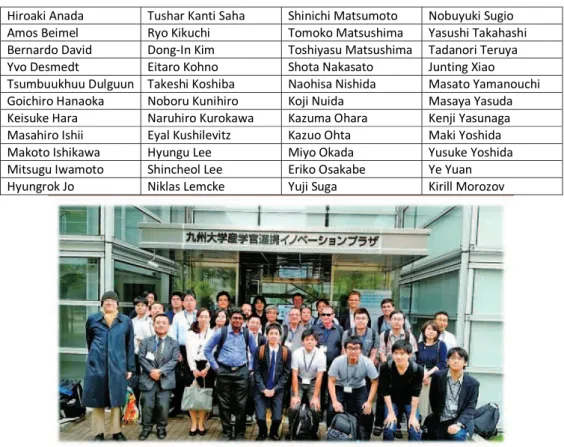
Table 1. List of attendees.
Hiroaki Anada Tushar Kanti Saha Shinichi Matsumoto Nobuyuki Sugio Amos Beimel Ryo Kikuchi Tomoko Matsushima Yasushi Takahashi Bernardo David Dong-In Kim Toshiyasu Matsushima Tadanori Teruya Yvo Desmedt Eitaro Kohno Shota Nakasato Junting Xiao Tsumbuukhuu Dulguun Takeshi Koshiba Naohisa Nishida Masato Yamanouchi Goichiro Hanaoka Noboru Kunihiro Koji Nuida Masaya Yasuda Keisuke Hara Naruhiro Kurokawa Kazuma Ohara Kenji Yasunaga Masahiro Ishii Eyal Kushilevitz Kazuo Ohta Maki Yoshida Makoto Ishikawa Hyungu Lee Miyo Okada Yusuke Yoshida Mitsugu Iwamoto Shincheol Lee Eriko Osakabe Ye Yuan Hyungrok Jo Niklas Lemcke Yuji Suga Kirill Morozov
Photograph 1. Group photo in front of the venue.
六本松
Hashimoto
Nishijin Tenjin
Hakozaki
Hakata
Fukuoka Airport
JR K ashii L
ine
JR K ag
oshim a L
ine Nis
hite tsu Om
uta L ine
Ropponmatsu Meinohama
J R Other Line Subway Urban Expressway Nishikyushu Expressway ▶200 meters from
the Fukuoka Tower Industry-University-Government Collaboration Innovation Plaza
IMI Joint Research Project in 2017
Cryptographic Technologies
for Securing Network Storage
and Their Mathematical Modeling
Amos Beimel,
Ben-Gurion University
“Graph Secret Sharing”
Yvo Desmedt,
The University of Texas at Dallas
“Human Recomputable Secret Shares and their Applications in E-Voting”
Eyal Kushilevitz,
Technion
“Ad-hoc MPC”
Keynote speakers:
Bernardo David,
Tokyo Institute of Technology
Mitsugu Iwamoto,
The University of Electro-Communications
Ryo Kikuchi,
NIPPON TELEGRAPH AND TELEPHONE CORPORATION
Takeshi Koshiba,
Waseda University
Naruhiro Kurokawa,
Bank of Japan
Kazuma Ohara,
NEC Corporation
Invited speakers:
■Organizing Committee▶ ■
Hiroaki Anada
(University of Nagasaki) ■Kirill Morozov
(Tokyo Institute of Technology) ■Yuji Suga
(Internet Initiative Japan Inc.)3-8-34 Momochihama Sawara-ku Fukuoka 814-0001, JAPAN https://airimaq.kyushu-u.ac.jp/en/airimaq/access.php
Venue:
AirIMaQ (Momochi), Seminar Room, 2F
Date:
June 12
(Mon)-
13
(Tue)
, 2017
http://www.imi.kyushu-u.ac.jp/eng/events/view/1240
(For general inquiries) Institute of Mathematics for Industry, Kyushu University TEL: 092-802-4402 E-mail: [email protected]
Contact
: [email protected]
■Sponsored by ▶ Institute of Mathematics for Industry, Kyushu University
■Registration fee ▶ Free
Industry-University-Government Collaboration Innovation Plaza
Program
June 12 (Monday)
10:00-10:10 (Opening)
[1] 10:10-10:50 [keynote] Amos Beimel, Ben-Gurion University, Israel
Graph Secret Sharing
[2] 11:10-11:50 [keynote] Yvo Desmedt, The University of Texas at Dallas, USA
Human Recomputable Secret Shares and their Applications in E-Voting
[3] 14:00-14:40
Mitsugu Iwamoto, The University of Electro-Communications, Japan
Secret Sharing Schemes under Guessing Secrecy
[4] 15:00-15:40
Naruhiro Kurokawa, Bank of Japan, Japan
Function Secret Sharing Using Fourier Basis
16:00-16:30 (Panel Discussion) Panelists: Bernardo David, Yvo Desmedt, Mitsugu Iwamoto,
Ryo Kikuchi, Naruhiro Kurokawa, Eyal Kushilevitz and Kazuma Ohara.
Moderator: Kirill Morozov
June 13 (Tuesday)
[5] 10:10-10:50 [keynote] Eyal Kushilevitz, Technion, Israel
Ad-hoc MPC
[6] 11:10-11:50
Takeshi Koshiba, Waseda University, Japan
Secure Message Transmission against Rational Adversaries
[7] 14:00-14:40
Kazuma Ohara, NEC Corporation, Japan
Optimized Honest-Majority MPC for Malicious Adversaries
- Breaking the 1 Billion-Gate Per Second Barrier
[8] 14:50-15:30
Ryo Kikuchi, NTT CORPORATION, Japan
Key components in MEVAL
[9] 15:40-16:20
Bernardo David, Tokyo Institute of Technology, Japan
A Provably Secure Proof-of-Stake Blockchain Protocol
16:20-16:30 (Closing)
Table of Contents
Linear Secret-Sharing Schemes for Forbidden Graph Access Structures
Amos Beimel (Ben-Gurion University, Israel)
Joint work with Oriol Farr s, Yuval Mintz, and Naty Peter
Human Recomputable Secret Shares and their Applications in E-Voting
Yvo Desmedt (The University of Texas at Dallas, USA)
Secret Sharing Schemes Under Guessing Secrecy
Mitsugu Iwamoto (The University of Electro-Communications, Japan)
Joint work with Junji Shikata
Function Secret Sharing Using Fourier Basis
Naruhiro Kurokawa (Bank of Japan, Japan)
Joint work with Takuya Ohsawa and Takeshi Koshiba
Ad Hoc PSM Protocols: Secure Computation Without Coordination
Eyal Kushilevitz (Technion, Israel)
Joint work with Amos Beimel and Yuval Ishai
Secure Message Transmission against Rational Adversaries
Takeshi Koshiba (Waseda University, Japan)
Joint work with Maiki Fujita
Optimized Honest-Majority MPC for Malicious Adversaries
- Breaking the 1 Billion-Gate Per Second Barrier
Kazuma Ohara (NEC Corporation, Japan)
Joint work with Toshinori Araki, Assi Barak, Jun Furukawa, Yehuda Lindell, Ariel Nof, Adi Watzman, Or Weinstein
Key components in MEVAL
Ryo Kikuchi (NTT Corporation, Japan)
Joint work with Dai Ikarashi, Koki Hamada, Koji Chida, Naoto Kiribuchi, Gembu Morohashi
Ouroboros: A Provably Secure Proof-of-Stake Blockchain Protocol
Bernardo David (Tokyo Institute of Technology, Japan)
Joint work with Aggelos Kiayias, Alexander Russell and Roman Oliynykov
Panel Discussion: Cryptographic Technologies for Securing Network Storage
and Their Mathematical Modeling
à
・・・・・・・・・・
1
・・・・・・・・・
10
・・・・・・・・・・・・・・・・・・
25
・・・・・・・・・・・・・・・・・・・・
38
・・・・・・・・・・
48
・・・・・・・・・・・・・・
56
・・・・・・・・・・・・・・・・・・
72
・・・・・・・・・・・・・・・・・・・・・・・・・・・
86
・・・・・・・・・・
100
・・・・・・・・・・・・・・・・・・・・・・・・
116
IMI Workshop: Cryptographic Technologies for Securing Network Storage and Their Mathematical Modeling
June 12–13, 2017, Kyushu University
Linear Secret-Sharing Schemes for Forbidden
Graph Access Structures
Amos Beimel (Joint work with Oriol Farr`
as, Yuval Mintz, and
Naty Peter)
Ben Gurion University of the Negev
[email protected]
A secret-sharing scheme realizes the forbidden graph access structure determined by
a graph
G
= (
V, E
) if a pair of vertices can reconstruct the secret if and only if it is
and edge of
G
. An important property of these schemes is that they can be used to
construct schemes for the conditional disclosure of secrets.
We study the complexity of realizing a forbidden graph access structure by linear
secret-sharing schemes. A secret-sharing is linear if the reconstruction of the secret from
the shares is a linear mapping. In many applications of secret sharing, it is required
that the scheme is linear. We provide efficient constructions and lower bounds on the
share size of linear secret-sharing schemes for sparse and dense graphs, closing the gap
between upper and lower bounds: Given a sparse graph with
n
vertices and at most
n
1+βedges, for some 0
≤
β <
1, we construct a linear secret-sharing scheme realizing
the forbidden graph access structure in which the total size of the shares is ˜
O
(
n
1+β/2).
We provide an additional construction showing that every dense graph with
n
vertices
and at least
(
n2)
−
n
1+βedges can be realized by a linear secret-sharing scheme with
the same share size.
We prove lower bounds on the share size of linear secret-sharing schemes realizing
forbidden graph access structures. We prove that for most forbidden graphs access
structures, the total share size of every linear secret-sharing scheme realizing the graph
is Ω(
n
3/2), this shows that construction of [Gay, Kerenidis, and Wee, CRYPTO 2015]
is optimal. Furthermore, we show that for every 0
< β
≤
1 there exist a graph with at
most
n
1+βedges and a graph with at least
(
n2
)
−
n
1+βedges, such that the total share size
of every linear secret-sharing scheme realizing these forbidden graph access structures
is Ω(
n
1+β/2). This shows that our constructions are optimal (up to poly-logarithmic
factors).
3742
Secret Sharing
3
6634 3441 2538 1329
3
Secret Sharing
[Shamir79,Blakley79,ItoSaitoNishizeki87]•Parties:
•Access Structure (collection of sets of parties)
•A scheme realizes if:
–Correctness: every authorized set can recover s
–Privacy: every unauthorized set cannot learn anything about
4
P1 P2 Pn
Dealer
s
s1
r
s2 sn
Secret Sharing
for Forbidden Graphs
Amos Beimel, Ben-Gurion University
Based on works with
Oriol Farras, Universitat Rovira i Virgili
Yuval Mintz, Naty Peter, Ben-Gurion University
Cryptographic Technologies for Securing Network Storage
June 12, 20171
3742
2538 3441 1329 6634
Secret Sharing
2
Secret Sharing
for Forbidden Graphs
Amos Beimel, Ben-Gurion University
Based on works with
Oriol Farras, Universitat Rovira i Virgili
Yuval Mintz, Naty Peter, Ben-Gurion University
Cryptographic Technologies for Securing Network Storage
June 12, 20171
3742
2538 3441 1329 6634
Secret Sharing
2
Shamir’s t-out-of-n Secret Sharing
•Access structure: = { ⊆ ∶ || ≥ } •Scheme:
•Dealer chooses a random polynomial
− −
– Share of :
s
5
•
Input: secret s∈ where > is a prime= () mod
Linear Secret Sharing
•Input: secret ∈
•Dealer chooses random elements , … , ∈ •Share :
•A vector over
•Each coordinate: a linear combination of and ,… ,
•Example 1: Shamir’s scheme:
• = () = + ⋅ + 2⋅ 2 + ⋯ + −⋅ − •Example 2: ∈ 2
•Dealer chooses , 2∈ 2 •= (, ⊕ ) •= ( ⊕ ) •= (, ⊕ ⊕ )
6
Shamir’s
t
-out-of-
n
Secret Sharing
5
•Access structure: •Scheme:
•Input: secret
s
•Dealer chooses a random polynomial
–Share of
:
s
where is a prime
Linear Secret Sharing
6
•Input: secret
•Dealer chooses random elements
•Share :
•A vector over
•Each coordinate: a linear combination of and
•Example 1:
•Dealer chooses
•
•
•
•Example 2 – Shamir’s scheme:
•
3742
Secret Sharing
3
6634 3441 2538 1329
3
Secret Sharing
[Shamir79,Blakley79,ItoSaitoNishizeki87]•Parties:
•Access Structure (collection of sets of parties)
•A scheme realizes if:
–Correctness: every authorized set can recover s
–Privacy: every unauthorized set cannot learn anything about
4
P1 P2 Pn
Dealer
s
s1
r
s2 sn
A Scheme Realizing a Forbidden Graph
9
•
• For every edge , – Give a random bit to and to
• can reconstruct the secret by performing xor on their shares.
• In addition, share using a 3-out-of- secret-sharing scheme
• Total share size:
Upper Bounds for Forbidden Graphs
10
• Every graph can be realized by a secret-sharing scheme with share size
LiuVaikuntanathanWee17]
• Every graph can be realized by a linear secret-sharing scheme with share size
GayKerenidisWee15]
• We consider linear secret sharing schemes
• Questions:
• If
contains few edges, can we realize it more efficiently?• Few = . Goal: better than
• If contains many edges, can we realize it more efficiently?
• Many =
Goal: better than
• If has an efficient scheme and we add and remove few edges, can we realize it efficiently?
Why Secret Sharing?
7
• Storing sensitive information – Robust key management
• Used in many secure protocols:
• multiparty computation
• threshold cryptography
• attribute-based encryption (ABE)
• access control
• oblivious transfer
• Most applications require linear secret-sharing schemes
• Most known schemes are linear
Schemes for Forbidden Graphs
[SunShieh97]
A scheme realizes a forbidden graph
if:• The parties are the set of vertices
• The authorized sets are:
• The edges in
• Every set of size at least
• The unauthorized sets are:
• The non-edges
• A single party (vertex)
8
Why Secret Sharing?
7
• Storing sensitive information – Robust key management
• Used in many secure protocols:
• multiparty computation
• threshold cryptography
• attribute-based encryption (ABE)
• access control
• oblivious transfer
• Most applications require linear secret-sharing schemes
• Most known schemes are linear
Schemes for Forbidden Graphs
[SunShieh97]
A scheme realizes a forbidden graph
if:• The parties are the set of vertices
• The authorized sets are:
• The edges in
• Every set of size at least
• The unauthorized sets are:
• The non-edges
• A single party (vertex)
8
Motivation
11
• Secret sharing for forbidden bipartite graphs are equivalent to conditional disclosure of secrets
• Used to construct symmetric private information retrieval and attribute based encryption
• Our goal: construct efficient linear secret-sharing schemes for specific families of forbidden graphs
• We want to understand if, for forbidden graphs, linear secret sharing requires shares of size
•
Conditional Disclosure of Secrets (CDS)
[GertnerIshaiKushilevitzMalkin98]
• Each party has a private input
• Both parties know a secret
• Shared randomness
• Referee knows
• A condition:
• Each party sends one message
• Correctness: If , Ref learns
• Security: If , Ref learns nothing
Ref
Learnsiff Alice Bob
Motivation
11• Secret sharing for forbidden bipartite graphs are equivalent to conditional disclosure of secrets
• Used to construct symmetric private information retrieval and attribute based encryption
• Our goal: construct efficient linear secret-sharing schemes for specific families of forbidden graphs
• We want to understand if, for forbidden graphs, linear secret sharing requires shares of size
•
Conditional Disclosure of Secrets (CDS)
[GertnerIshaiKushilevitzMalkin98]
• Each party has a private input
• Both parties know a secret
• Shared randomness
• Referee knows
• A condition:
• Each party sends one message
• Correctness: If , Ref learns
• Security: If , Ref learns nothing
Ref
Learnsiff
Alice Bob
A Scheme Realizing a Forbidden Graph
9
•
• For every edge , – Give a random bit to and to
• can reconstruct the secret by performing xor on their shares.
• In addition, share using a 3-out-of- secret-sharing scheme
• Total share size:
Upper Bounds for Forbidden Graphs
10
• Every graph can be realized by a secret-sharing scheme with share size
LiuVaikuntanathanWee17]
• Every graph can be realized by a linear secret-sharing scheme with share size
GayKerenidisWee15]
• We consider linear secret sharing schemes
• Questions:
• If
contains few edges, can we realize it more efficiently?• Few = . Goal: better than
• If contains many edges, can we realize it more efficiently?
• Many =
Goal: better than
• If has an efficient scheme and we add and remove few edges, can we realize it efficiently?
Main Result: Upper Bounds
Thm 1:
If a graph withvertices contains for some
– either at most edges or
– at least
edges,
Then there is a linear secret-sharing scheme realizing the graphwith total share size
Thm 2: If
– can be realized with a scheme with total share size – obtained from by removing and adding at most edges. Then there is a linear secret-sharing scheme realizing with share size
.
15
Main Result: Lower Bounds
• Thm 3: There exists a graph with vertices such that in any linearsecret-sharing scheme realizing it with a one-bit secret the size of the shares is
• Conclusion 1: The construction of Gay et al. is optimal
• Conclusion 2: Gap between linear and non-linear schemes for forbidden graphs
• Thm 4: There exists a graph with vertices and at most edges
such that in any linear secret-sharing scheme realizing it with a one-bit secret the size of the shares is
– Same result for a graph with at least
edges
• Conclusion 3: Our constructions are optimal up to a poly-log factor.
16
CDS and Forbidden Bipartite Secret Sharing
• Bipartite Graph: • Vertices:
• Edges: Only between sets
• Secret sharing for forbidden bipartite graph
• Every can reconstruct • Every s.t.
should not learn information about
CDS and Forbidden Bipartite Secret Sharing
• Given a CDS define: •
• • To share a secret :
•
• can reconstruct iff
iff
Ref
Learnsiff
Alice Bob 00 01 11 10 00 01 11 10
can reconstruct iff
CDS and Forbidden Bipartite Secret Sharing
• Bipartite Graph: • Vertices:
• Edges: Only between sets
• Secret sharing for forbidden bipartite graph
• Every can reconstruct • Every s.t.
should not learn information about
CDS and Forbidden Bipartite Secret Sharing
• Given a CDS define: •
• • To share a secret :
•
• can reconstruct iff
iff
Ref
Learnsiff
Alice Bob 00 01 11 10 00 01 11 10
can reconstruct iff
A Scheme for a Graph with
Edges
• Basic Construction: for a bipartite graph such that is small and every vertex in has degree at most
• Share size
• Second construction: for a bipartite such that every vertex in has degree at most
– Share size
• Third construction: for a bipartite graph that has at most edges
– Share size
• Final construction: for a graph that has at most
edges
–Share size
17
Basic Construction
• If isbipartite graph s.t. every vertex in has degree at most
• Then has a linear secret-sharing with total share size is
Example: ,
Every has degree at most The total share size is
18 A Scheme for a Graph with
Edges
• Basic Construction: for a bipartite graph
such that is small and every vertex in has degree at most
• Share size
• Second construction: for a bipartite such that every vertex in has degree at most
– Share size
• Third construction: for a bipartite graph that has at most edges
– Share size
• Final construction: for a graph that has at most
edges
–Share size
17
Basic Construction
• If isbipartite graph s.t. every vertex in has degree at most
• Then has a linear secret-sharing with total share size is
Example: ,
Every has degree at most The total share size is
18 Main Result: Upper Bounds
Thm 1:
If a graph withvertices contains for some
– either at most edges or
– at least
edges,
Then there is a linear secret-sharing scheme realizing the graphwith total share size
Thm 2: If
– can be realized with a scheme with total share size – obtained from by removing and adding at most edges. Then there is a linear secret-sharing scheme realizing with share size
.
15
Main Result: Lower Bounds
• Thm 3: There exists a graph with vertices such that in any linearsecret-sharing scheme realizing it with a one-bit secret the size of the shares is
• Conclusion 1: The construction of Gay et al. is optimal
• Conclusion 2: Gap between linear and non-linear schemes for forbidden graphs
• Thm 4: There exists a graph with vertices and at most edges
such that in any linear secret-sharing scheme realizing it with a one-bit secret the size of the shares is
– Same result for a graph with at least
edges
• Conclusion 3: Our constructions are optimal up to a poly-log factor.
16
Bipartite with Few Edges
If isbipartite with at most edges
Then has a linear secret-sharing with total share size is
• In this talk:
Scheme:
• Let
•
• Realize
– Share size
• Realize
– Share size
• In the paper: Reduce degree in steps
23
Conclusions
• Forbidden graph secret sharing is equivalent to CDS ⇨ SPIR, Atribute based encryption
• Every forbidden graph can be realized by a linear secret-sharing scheme with share size
• We show that every forbidden graph with edges can be realized
by a linear secret-sharing scheme with share size – Same result for with
edges
• There exists a forbidden graph such that in any linear secret-sharing scheme realizing it the share size is
• There exists a forbidden graph with edges such that in any linear
secret-sharing scheme realizing it the share size is • Open: graph access structures
24
A Scheme with share size
• If = , , is bipartite graph
• Then has a linear secret-sharing with total share size is(/)
Scheme:
• Partitioninto sets, … , of size
• Define= , , ∩ (×)
• Realize eachwith a scheme with total share size
• The total share size is ( ⋅ )
A Scheme with share size
• If = , , is bipartite graph s.t.
– The degree of every ∈ is at most • Then has a linear secret-sharing with
total share size is (/2)
With different parameters :
• Randomly partition into:
, … , of size /
• Define= , , ∩ (×)
– With high prob. the degree of every ∈ in
is at most
• Realize each with a scheme with total share size + (/ ) ⋅ = ()
• The total share size is ( ⋅ )
22
A Scheme with share size
• If isbipartite graph
• Then has a linear secret-sharing with total share size is
Scheme:
• Partition into sets of size • Define • Realize each with a scheme with total
share size
• The total share size is
21
A Scheme with share size
• If isbipartite graph s.t.
– The degree of every is at most
• Then has a linear secret-sharing with total share size is
Scheme:
• Randomly partition into sets
of size • Define
– With high prob. the degree of every in
is at most
• Realize each with a scheme with total
share size
• The total share size is
22
With different parameters:• Schemewith total share size
Schemes for Graphs
A scheme realizes a graph
if:• The parties are the set of vertices
• The authorized sets are:
• The edges in
• Every set that contains an edge
• The unauthorized sets are:
• The non-edges
• Every set that doesn’t contain an edge
• Every graph can be realized by a linear scheme with share size
• Sparse graph:
•
25
Thanks!
26
Schemes for Graphs
A scheme realizes a graph
if:• The parties are the set of vertices
• The authorized sets are:
• The edges in
• Every set that contains an edge
• The unauthorized sets are:
• The non-edges
• Every set that doesn’t contain an edge
• Every graph can be realized by a linear scheme with share size
• Sparse graph:
•
25
Thanks!
26
Bipartite with Few Edges
If isbipartite with at most edges
Then has a linear secret-sharing with total share size is
• In this talk:
Scheme:
• Let
•
• Realize
– Share size
• Realize
– Share size
• In the paper: Reduce degree in steps
23
Conclusions
• Forbidden graph secret sharing is equivalent to CDS ⇨ SPIR, Atribute based encryption
• Every forbidden graph can be realized by a linear secret-sharing scheme with share size
• We show that every forbidden graph with edges can be realized
by a linear secret-sharing scheme with share size – Same result for with
edges
• There exists a forbidden graph such that in any linear secret-sharing scheme realizing it the share size is
• There exists a forbidden graph with edges such that in any linear
secret-sharing scheme realizing it the share size is • Open: graph access structures
24
IMI Workshop: Cryptographic Technologies for Securing Network Storage and Their Mathematical Modeling
June 12–13, 2017, Kyushu University
Human Recomputable Secret Shares
and their Applications in E-Voting
Yvo Desmedt
The University of Texas at Dallas
[email protected]
The classical approach of secret sharing is to consider the secret to be in a finite
field. Computers are used by the dealer to make shares, and computers are used to
reconstruct the secret. Since the invention of Visual Cryptography by Kafri and Keren
in 1987, many researchers have stepped away from these restrictions.
In 2007, Desmedt-Pieprzyk-Steinfeld-Wang considered secrets that belong to a
non-Abelian group, such as the symmetric group (i.e., permutations), to obtain secure
multiparty computation.
In this talk, we consider secret and shares that are permutations, wonder how good
humans can do computations with these and consider them in the context of e-voting,
but then e-voting secure against hacking of the voter’s computer.
•a joint paper with Stelios Erotokritou at SCN 2012.
•a joint paper with Stelios Erotokritou at Vote ID 2015.
Special thanks to Rene Peralta whose November 9, 2011 suggestion to considerZ10(+)as an Abelian subgroup ofS10, allowed us to make
a more user-friendly scheme.
c
�Yvo Desmedt 2
O
VERVIEW1. Special Secret Sharing Schemes
2. Our setting: Post Snowden elections
3. A pioneering approach: Chaum’s Code Voting 4. Advantages/disadvantages of Code Voting
5. Our setting, assumptions and their impacts
6. The voting: passive adversary only 7. Some usability tests (SCN 2012)
8. High level description 9. Details: technical background
10. The mixing for the single-seat: Efficiency improvement
11. The mixing for the single-seat MIX-friendly case
c
�Yvo Desmedt 3
Human Recomputable Secret Shares and
their Applications in E-Voting
Yvo Desmedt
Univ. of Texas at Dallas, US
June 12, 2017
c
�Yvo Desmedt
Yvo Desmedt’s work on anonymity was partially supported by: the US NSF ANI-0087641. The work on voting was partially sponsored by the UK EPSRC EP/C538285/1, by BT as BT Chair of Information Security and partly done while being Invited Senior Research Scientist at RCIS (AIST, Japan).
A part of this research was done while Yvo Desmedt visited AT&T Shannon Research, Tsinghua University (while funded by the National Natural Science Foundation of China Grant 60553001, and the National Basic Research Program of China Grant 2007CB807900 and 2007CB807901).
Part of this presentation is based on:
•unpublished research with Rebecca Wright (with her permission),
•a joint paper with Josef Pieprzyk, Ron Steinfeld and Huaxiong Wang (Crypto 2007)
c
�Yvo Desmedt 1
Human Recomputable Secret Shares and
their Applications in E-Voting
Yvo Desmedt
Univ. of Texas at Dallas, US
June 12, 2017
c
�Yvo Desmedt
Yvo Desmedt’s work on anonymity was partially supported by: the US NSF ANI-0087641. The work on voting was partially sponsored by the UK EPSRC EP/C538285/1, by BT as BT Chair of Information Security and partly done while being Invited Senior Research Scientist at RCIS (AIST, Japan).
A part of this research was done while Yvo Desmedt visited AT&T Shannon Research, Tsinghua University (while funded by the National Natural Science Foundation of China Grant 60553001, and the National Basic Research Program of China Grant 2007CB807900 and 2007CB807901).
Part of this presentation is based on:
•unpublished research with Rebecca Wright (with her permission),
•a joint paper with Josef Pieprzyk, Ron Steinfeld and Huaxiong Wang (Crypto 2007)
c
�Yvo Desmedt 1
12. The mixing for the multi-seat election
13. The active case: An announcement
14. Variants 15. Conclusions
c
�Yvo Desmedt 4
1.
S
PECIALS
ECRETS
HARINGS
CHEMESThe most known secret sharing scheme is Shamir’s secret sharing scheme (over 11,000 citations). His approach was to consider:
1.thesecret and sharesto be in afinite field,
2.to have the dealer use acomputertogenerate shares, and 3.to usecomputers to reconstruct the secret.
Since the invention of Visual Cryptography by Kafri and Keren in 1987, many researchers have stepped away from these restrictions (note that this was reinvented by Naor and Shamir in 1994 and that Kafri-Keren have 225 citations and Naor-Shamir have 2741).
Generalizing from finite field to Abelian Groups was initiated by
c
�Yvo Desmedt 5
12. The mixing for the multi-seat election
13. The active case: An announcement
14. Variants 15. Conclusions
c
�Yvo Desmedt 4
1.
S
PECIALS
ECRETS
HARINGS
CHEMESThe most known secret sharing scheme is Shamir’s secret sharing scheme (over 11,000 citations). His approach was to consider:
1.thesecret and sharesto be in afinite field,
2.to have the dealer use acomputertogenerate shares, and 3.to usecomputers to reconstruct the secret.
Since the invention of Visual Cryptography by Kafri and Keren in 1987, many researchers have stepped away from these restrictions (note that this was reinvented by Naor and Shamir in 1994 and that Kafri-Keren have 225 citations and Naor-Shamir have 2741).
Generalizing from finite field to Abelian Groups was initiated by
c
�Yvo Desmedt 5
•a joint paper with Stelios Erotokritou at SCN 2012.
•a joint paper with Stelios Erotokritou at Vote ID 2015.
Special thanks to Rene Peralta whose November 9, 2011 suggestion to considerZ10(+)as an Abelian subgroup ofS10, allowed us to make
a more user-friendly scheme.
c
�Yvo Desmedt 2
O
VERVIEW1. Special Secret Sharing Schemes
2. Our setting: Post Snowden elections
3. A pioneering approach: Chaum’s Code Voting
4. Advantages/disadvantages of Code Voting 5. Our setting, assumptions and their impacts
6. The voting: passive adversary only
7. Some usability tests (SCN 2012) 8. High level description
9. Details: technical background
10. The mixing for the single-seat: Efficiency improvement 11. The mixing for the single-seat MIX-friendly case
c
�Yvo Desmedt 3
3.
A
PIONEERING APPROACH: C
HAUM’
SC
ODEV
OTINGc
�Yvo Desmedt and Stelios Erotokritou 8
c
�Yvo Desmedt and Stelios Erotokritou 9
Desmedt-Frankel, published in 1994 (see also: Cramer-Fehr, Cramer-Fehr-Stam and the Cramer-Fehr-Ishai-Kushilevitz application to MPC).
After many years of research, in 2007 Desmedt-Pieprzyk-Steinfeld-Wang succeeded in making black-box “MPC” computations over non-Abelian groups. The motivation was purely theoretical. Today we will see an application of the situation in which:
the secret and shares belongs to a non-Abelian group, i.e.,Sn(or a subgroup ofSn, such asZn).
c
�Yvo Desmedt 6
2.
O
UR SETTING: P
OSTS
NOWDEN ELECTIONSPost Snowden: today most people understand that computers, laptops can be hacked and may have trapdoors, malware, etc.
Potential solutions:
•Halderman (2015) recommended to stop using Internet Voting.
•We believe we need to restart/encourage a line of research in which we wonder how to vote assuming that the device you use for voting
has been hacked.
Our model(high level): we assume we cannottrust:
•any single party,
•any single device, etc.
c
�Yvo Desmedt 7
Desmedt-Frankel, published in 1994 (see also: Cramer-Fehr, Cramer-Fehr-Stam and the Cramer-Fehr-Ishai-Kushilevitz application to MPC).
After many years of research, in 2007 Desmedt-Pieprzyk-Steinfeld-Wang succeeded in making black-box “MPC” computations over non-Abelian groups. The motivation was purely theoretical. Today we will see an application of the situation in which:
the secret and shares belongs to a non-Abelian group, i.e.,Sn(or a subgroup ofSn, such asZn).
c
�Yvo Desmedt 6
2.
O
UR SETTING: P
OSTS
NOWDEN ELECTIONSPost Snowden: today most people understand that computers, laptops can be hacked and may have trapdoors, malware, etc.
Potential solutions:
•Halderman (2015) recommended to stop using Internet Voting.
•We believe we need to restart/encourage a line of research in which we wonder how to vote assuming that the device you use for voting
has been hacked.
Our model(high level): we assume we cannottrust:
•any single party,
•any single device, etc.
c
�Yvo Desmedt 7
4.
A
DVANTAGES/
DISADVANTAGES OF CODE VOTINGAdvantages of Code Voting:secure even if voter’s machine hacked.
Disadvantages:
•requires IACR to send random numbers by postal mail, and
•no collusion between postal system (or sender of envelopes) and the party receiving the vote.
•authorities do not like the system because it differs too much from what is used today!
c
�Yvo Desmedt 10
Ballot stuffing with Code Voting
c
�Yvo Desmedt and Stelios Erotokritou 11
4.
A
DVANTAGES/
DISADVANTAGES OF CODE VOTINGAdvantages of Code Voting:secure even if voter’s machine hacked.
Disadvantages:
•requires IACR to send random numbers by postal mail, and
•no collusion between postal system (or sender of envelopes) and the party receiving the vote.
•authorities do not like the system because it differs too much from what is used today!
c
�Yvo Desmedt 10
Ballot stuffing with Code Voting
c
�Yvo Desmedt and Stelios Erotokritou 11
3.
A
PIONEERING APPROACH: C
HAUM’
SC
ODEV
OTINGc
�Yvo Desmedt and Stelios Erotokritou 8
c
�Yvo Desmedt and Stelios Erotokritou 9
6.
T
HE VOTING:
PASSIVE ADVERSARY ONLYA user friendly approach: (multi-seat, not “code-voting”,t= 1)
c
�Yvo Desmedt and Stelios Erotokritou 14
6.
T
HE VOTING:
PASSIVE ADVERSARY ONLYA user friendly approach: (multi-seat, not “code-voting”,t= 1)
c
�Yvo Desmedt and Stelios Erotokritou 14
5.
O
UR SETTING,
ASSUMPTIONS AND THEIR IMPACTSOur setting:
1.Voter votes using an untrusted device
2.The voter has access to many communication devices/media (e.g., home PC, mobile, at work, in the library, postal)
3.Voter uses “human computations,”which we checked on reliability (see further).
4.Authoritiesuse untrusted computers, potentially with state sponsored malware.
c
�Yvo Desmedt 12
Our first model:
1.at mosttdevices/parties are infected.
2.our adversary is passive, curious, but not interested in: modifying the vote, in a DoS, etc. (see further)
Impact:
•Many cryptographic tools become useless, such as: AES, ElGamal, ZKIP, NIZK.
•So, we need to make a new MIX
c
�Yvo Desmedt 13
5.
O
UR SETTING,
ASSUMPTIONS AND THEIR IMPACTSOur setting:
1.Voter votes using an untrusted device
2.The voter has access to many communication devices/media (e.g., home PC, mobile, at work, in the library, postal)
3.Voter uses “human computations,”which we checked on reliability (see further).
4.Authoritiesuse untrusted computers, potentially with state sponsored malware.
c
�Yvo Desmedt 12
Our first model:
1.at mosttdevices/parties are infected.
2.our adversary is passive, curious, but not interested in: modifying the vote, in a DoS, etc. (see further)
Impact:
•Many cryptographic tools become useless, such as: AES, ElGamal, ZKIP, NIZK.
•So, we need to make a new MIX
c
�Yvo Desmedt 13
6.
T
HE VOTING:
PASSIVE ADVERSARY ONLYA user friendly approach: (multi-seat, not “code-voting”,t= 1)
� �� �
φi
14
6.
T
HE VOTING:
PASSIVE ADVERSARY ONLYA user friendly approach: (multi-seat, not “code-voting”,t= 1)
� �� �
φi 14
6.
T
HE VOTING:
PASSIVE ADVERSARY ONLYA user friendly approach: (multi-seat, not “code-voting”,t= 1)
� �� �
φi
14
6.
T
HE VOTING:
PASSIVE ADVERSARY ONLYA user friendly approach: (multi-seat, not “code-voting”,t= 1)
� �� �
φi
14
6.
T
HE VOTING:
PASSIVE ADVERSARY ONLYA user friendly approach: (multi-seat, not “code-voting”,t= 1)
c
�Yvo Desmedt and Stelios Erotokritou 14
6.
T
HE VOTING:
PASSIVE ADVERSARY ONLYA user friendly approach: (multi-seat, not “code-voting”,t= 1)
c
�Yvo Desmedt and Stelios Erotokritou 14
Details:
We asked 100 participants to do several tests (their ages did not
surpass 65).
Asking to add 5 shares of 4 digitsmod10, 95% of the people computed the correct result, using the above visual tool to avoid
confusion.
However, when using the permutation based addition, 99% of the
people computed the correct result.
A common comment from the participants was that the permutation
basedmod10addition was extremely easy - whereas the other experiment was rather challenging for some people.
c
�Yvo Desmedt 17
8.
H
IGH LEVEL DESCRIPTIONBackground: secret shares
Example: 2-out-of-2:
Goal:Give binary secretsto 2 parties, Alice and Bob.
How:Flip a coin. Give the result,s1, to Alice.
Give Bob:s⊕s1.
Can begeneralizedto:
•work over any finite group,
•the case we donottrusttinsiders. Just lets=s1◦s2◦ · · · ◦st+1.
c
�Yvo Desmedt 18
In the single-seat election (mix friendly), we use code-voting (t= 1)
We regard the Abelian groupZ10(+)as a subgroup ofS10and
replace the above “shares” by e.g.,
Put this edge against Arrow Sheet 2 Put this edge
against "Trace the Line" edge
Sheet 1 Sheet 2
Put against "Secret Bullets" Put against
Sheet 1
These corresponding to an addition plus 4mod10and plus 3
mod10respectively. We assume there are 10 candidates.
15
7.
S
OME USABILITY TESTS(SCN 2012)
How good are users able to add strings of numbers, eachmod10? Our test show only 95% get this correct, even when helping users, as following:
2597 Your Secret is: Please re-write your secret:
2 5 9 7
+
+
+
+
7 2 9 1 1 6 5 8 9 2 0 2 7 4 8 4 8 1 7 2 1 8 2 4 2 9 5 0 8 7 2 6 2 4 1 7 1 9 7 8 1 7
2 9
1 5
3 2
Share 1 Share 2 Share 3 Share 4 Share 5
16
In the single-seat election (mix friendly), we use code-voting (t= 1)
We regard the Abelian groupZ10(+)as a subgroup ofS10and
replace the above “shares” by e.g.,
Put this edge against Arrow Sheet 2 Put this edge
against "Trace the Line" edge
Sheet 1 Sheet 2
Put against "Secret Bullets" Put against
Sheet 1
These corresponding to an addition plus 4mod10and plus 3
mod10respectively. We assume there are 10 candidates.
15
7.
S
OME USABILITY TESTS(SCN 2012)
How good are users able to add strings of numbers, eachmod10? Our test show only 95% get this correct, even when helping users, as following:
2597 Your Secret is: Please re-write your secret:
2 5 9 7
+
+
+
+
7 2 9 1 1 6 5 8 9 2 0 2 7 4 8 4 8 1 7 2 1 8 2 4 2 9 5 0 8 7 2 6 2 4 1 7 1 9 7 8 1 7
2 9
1 5
3 2
Share 1 Share 2 Share 3 Share 4 Share 5
16
High level protocol description:
1.We use aCode Generation Entity(CGE), which will in the pre-voting stage chooseinitialone-time pad (informally,πi) for each
voter.
2.Our MIX network uses layers, each layer having at leastt+ 1
shares.
3.The CGE sends shares (t+ 1) of theseπito the MIX servers in the
first layer.
4.The MIX network anonymizes and modifies the shares ofπi. The
permutations used are the same for all the shares of the same value. For this, each layer had aleaderthat remembers the permutation used and the modifications done at that layer.
c
�Yvo Desmedt 19
5.Each server in the last layer of the MIX sends a share to each voter (communication paths used by different servers are vertex disjoint).
6.The voter combines the shares (see above) and votes.
7.The voter sends the “encrypted” vote back to the leader of the last layer of the MIX network.
8.Starting with the leader of the last layer, all permutations and modifications done at that layer are undone.
9.The leader of the first layer of the MIX sends the almost-unencrypted vote to the CGI.
10.The CGI uses the inverse of its one-time pad.
c
�Yvo Desmedt 20
High level protocol description:
1.We use aCode Generation Entity(CGE), which will in the pre-voting stage chooseinitialone-time pad (informally,πi) for each
voter.
2.Our MIX network uses layers, each layer having at leastt+ 1
shares.
3.The CGE sends shares (t+ 1) of theseπito the MIX servers in the
first layer.
4.The MIX network anonymizes and modifies the shares ofπi. The
permutations used are the same for all the shares of the same value. For this, each layer had aleaderthat remembers the permutation used and the modifications done at that layer.
c
�Yvo Desmedt 19
5.Each server in the last layer of the MIX sends a share to each voter (communication paths used by different servers are vertex disjoint).
6.The voter combines the shares (see above) and votes.
7.The voter sends the “encrypted” vote back to the leader of the last layer of the MIX network.
8.Starting with the leader of the last layer, all permutations and modifications done at that layer are undone.
9.The leader of the first layer of the MIX sends the almost-unencrypted vote to the CGI.
10.The CGI uses the inverse of its one-time pad.
c
�Yvo Desmedt 20
Details:
We asked 100 participants to do several tests (their ages did not
surpass 65).
Asking to add 5 shares of 4 digitsmod10, 95% of the people computed the correct result, using the above visual tool to avoid
confusion.
However, when using the permutation based addition, 99% of the
people computed the correct result.
A common comment from the participants was that the permutation
basedmod10addition was extremely easy - whereas the other experiment was rather challenging for some people.
c
�Yvo Desmedt 17
8.
H
IGH LEVEL DESCRIPTIONBackground: secret shares
Example: 2-out-of-2:
Goal:Give binary secretsto 2 parties, Alice and Bob.
How:Flip a coin. Give the result,s1, to Alice.
Give Bob:s⊕s1.
Can begeneralizedto:
•work over any finite group,
•the case we donottrusttinsiders. Just lets=s1◦s2◦ · · · ◦st+1.
c
�Yvo Desmedt 18
10.
T
HE MIXING FOR THE SINGLE-
SEATMIX-
FRIENDLY CASEWe have several protocols, of which we describe the simplest.
In the simplest, we require that each server in layeriis physically different from each server in layerj(i�=j).
Note: Our MIX-friendly protocols can also be used in situations in which we have a single receiver (can be generalized) and multiple senders. The receiver should not learn who the sender is. For simplicity we focus on voting.
In below protocol we assume thatb=t+ 1. We denote the servers in layeriby a “block”Bi.
Protocol1. Prevotingprotocol
Step 1Letπ1
i be theithone-time pad (where1≤i≤v). The receiver
c
�Yvo Desmedt 23
(CGI) shares eachπ1
i intot+ 1sharesπi,j1 ∈F2l(where
1≤j≤t+ 1) and privately sendsπ1
i,jto the corresponding MIX
M IX1,jin blockB1.
Step 2TheleaderofB1(we callM IX1,1) informs all others MIX servers
inB1how they have to permute thei-index of all aboveπi,j1. This permutation is defined byρ1∈RSv.
Step 3On theiindices all MIX servers inB1apply the permutationρ1. So,
π1
i,j:=π1ρ1(i),j.
Step 4TheleaderofB1choosest+ 1random bit string modifiers
ω1
i,j∈RF2land privately sendsω1i,jto parties inB1.
Step 5For each(i, j)thet+ 1valuesπ1
i,jare regarded as shares ofπ1i. Similarly, thet+ 1valuesω1
i,jare regarded as shares ofω1i.
c
�Yvo Desmedt 24
9.
D
ETAILS:
TECHNICAL BACKGROUNDWe primarily use (besides MIX and shares):
•Concepts fromsecure multiparty computation
Simplified goal: given shares ofsand shares ofuhow to make shares ofs∗u,withoutcomputingsandu.
•Desmedt-Kurosawa 2000 introduced:
Definition1. We say that(X,B)is an(n, b, t)-verifiers set system if: 1.|X|=n,
2.|Bi|=t+ 1fori= 1,2, . . . , b, and
3.for any subsetF⊂Xwith|F| ≤t, there exists aBi∈ B such thatF∩Bi=∅.
c
�Yvo Desmedt 21
Vertex disjoint paths: pathsp1andp2fromStoRare vertex disjoint
if the nodes on pathp1, and onp2, except forSandRare disjoint.
c
�Yvo Desmedt 22
9.
D
ETAILS:
TECHNICAL BACKGROUNDWe primarily use (besides MIX and shares):
•Concepts fromsecure multiparty computation
Simplified goal: given shares ofsand shares ofuhow to make shares ofs∗u,withoutcomputingsandu.
•Desmedt-Kurosawa 2000 introduced:
Definition1. We say that(X,B)is an(n, b, t)-verifiers set system if: 1.|X|=n,
2.|Bi|=t+ 1fori= 1,2, . . . , b, and
3.for any subsetF⊂Xwith|F| ≤t, there exists aBi∈ B such thatF∩Bi=∅.
c
�Yvo Desmedt 21
Vertex disjoint paths: pathsp1andp2fromStoRare vertex disjoint
if the nodes on pathp1, and onp2, except forSandRare disjoint.
c
�Yvo Desmedt 22